
Your skin is different now. You can feel it.
The cream that worked for years suddenly stings. Your face is drier, or red in places it never used to be, or breaking out like you’re 15 again. And the aisle of products promising to fix it all has never been more crowded or more confusing.
Skincare over 50 isn’t about chasing the face you had at 25. It’s about figuring out what your skin needs now, how it affects your inside and outside, and what to stop using.
I spent most of my life fighting my own skin. Chronic dermatitis. Rosacea. Dry patches that came back no matter what the dermatcologist prescribed. So when I tell you what changed, it is not a sales pitch for products to sell you that I haven’t actually used the past 2 years. It’s from my own bathroom counter, after decades of listening to the professionals and getting it all wrong
Disclosure: This post contains affiliate links. If you purchase through our links we may earn a small commission at no extra cost to you. We only recommend products Wendy personally uses and believes in. Read our full Affiliate Disclosure here.
Why Does My Skin React to Everything now that i’m over 50
After 50, falling estrogen thins your skin, slows oil production, and weakens the skin barrier. That makes skin drier, more sensitive, and quicker to react to products it tolerated for years. Ingredients that felt fine at 30, strong actives, added fragrance, foaming cleansers, can suddenly trigger redness, stinging, or breakouts.
That barrier shift is what we are never told about. Research on menopause and skin points to declining estrogen levels, which can make skin thinner, drier, and more reactive. So the product isn’t always the problem. Sometimes the product is the same, and your skin is what’s changed.
For me, the hormone changes after 50 showed up in ways nobody else could see. Thinner hair. Nails that bent and split. Skin that drank moisture and stayed thirsty, making me see fine lines that weren’t there the day before. From the outside, I don’t look my age, and I’m grateful for that. But I knew. I could feel my skin changing.
The B in GutBeautyBody is intentional. When your skin looks and feels better, you feel better and walk through your day more confidently. After 50, with hormones leaving the building, you have to pay attention to beauty on the inside and the outside at the same time. They’re not separate conversations anymore.
In the photos below, I wasn’t having any skin ‘issue,’ but you can just see the redness and texture. If you scroll a bit, you can see what a breakout looks like. I haven’t had a single skin breakout since June 2024 after learning about skincare products and ingredients.
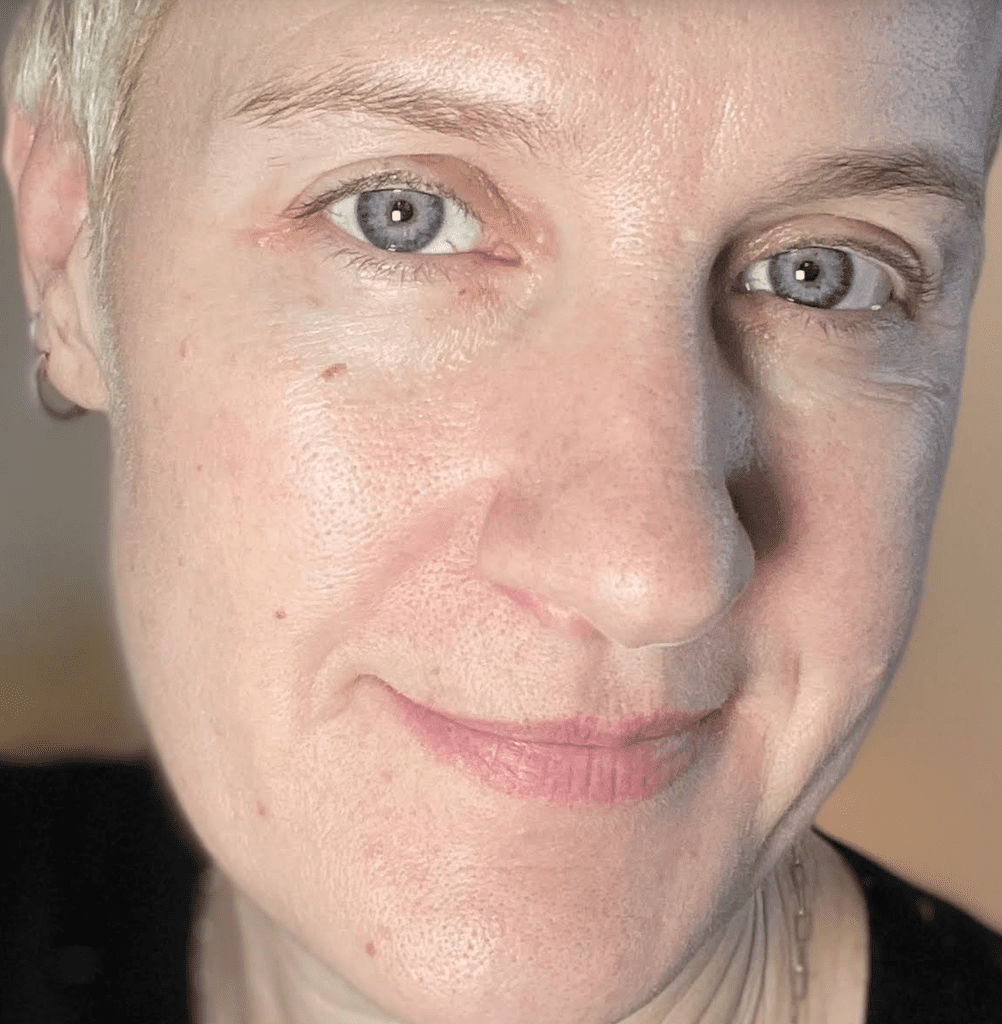
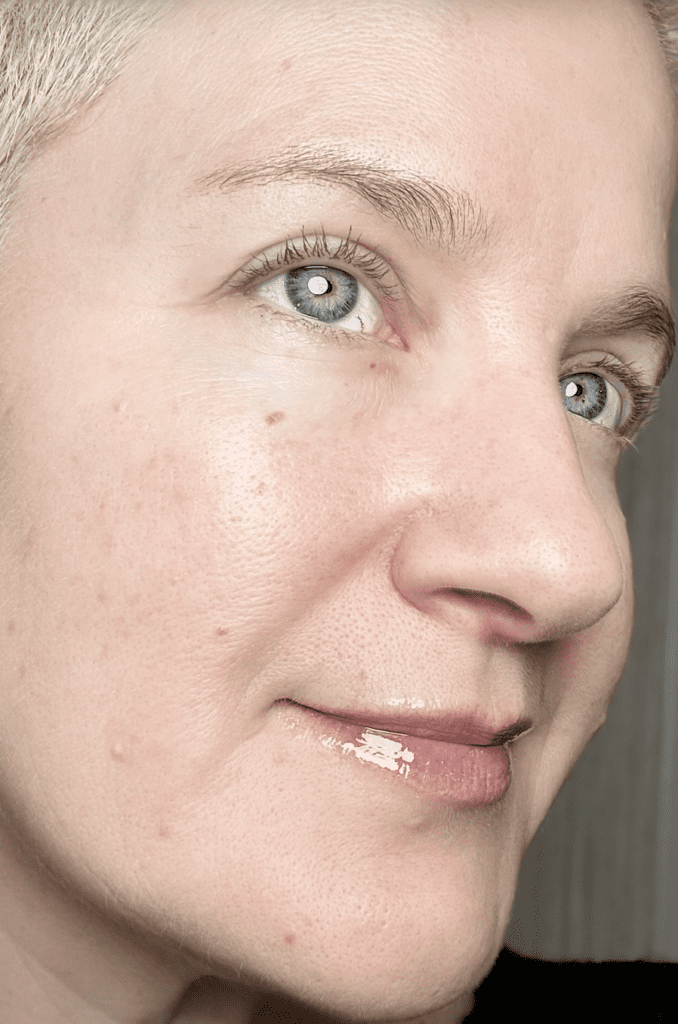
What I Stopped Putting on My Skin
For most of my life, I put on whatever the store shelf or the doctor handed me. I never turned the bottle over and read the back. I’d open a bottle of shampoo and smell it. That’s about it. I’m not saying those products poisoned me. I’m saying I had no idea what was in them or what they did, and I used them every single day for decades, and used them on our kids too.
20 years ago I became enlightened about food and what we put in our bodies as medicine or poison, yet here I was not even realizing that the other products we used were part of the same equation.
That’s the part that gets me now. We’re all out here trying to look and smell our best, rubbing things into our skin twice a day, and most of us can’t name three ingredients in our own moisturizer.
Once I started actually reading labels, a few things jumped out. Parabens and phthalates are found in many personal care products and are flagged as endocrine disruptors that the skin can absorb. Synthetic fragrance is its own rabbit hole, and the word “fragrance” on a label can legally hide a whole list of things you will never see. I am someone who gets an actual headache from heavy synthetic scent, so that one was personal.
This is the same move we made with our toothpaste. Once you start reading one label, you can’t stop reading the rest. Different shelves, same lessons.
Then there’s sunscreen, which deserves its own moment.
We’re told to use reef-safe mineral sunscreen when we swim in the ocean because the chemicals in regular sunscreen can harm coral and other marine life. Hawaii banned the sale of sunscreens with oxybenzone and octinoxate for exactly that reason, and NOAA has documented how those chemicals threaten reef ecosystems. Palau, Aruba, and others followed.
So here is my honest question. If these chemicals are harmful enough that entire islands ban them to protect fish, why are we rubbing them into our own bodies every day without a second thought?
And it turns out the dots connect. The FDA’s own study found that those same chemical sunscreen filters absorb into the bloodstream after a single day of use. The FDA was careful to say that absorbing into your body does not automatically mean a thing is unsafe. It means it has not been fully tested, and they want more data. Fair enough. But that’s exactly the point. We’ve been using this stuff for decades, and the testing is still catching up.
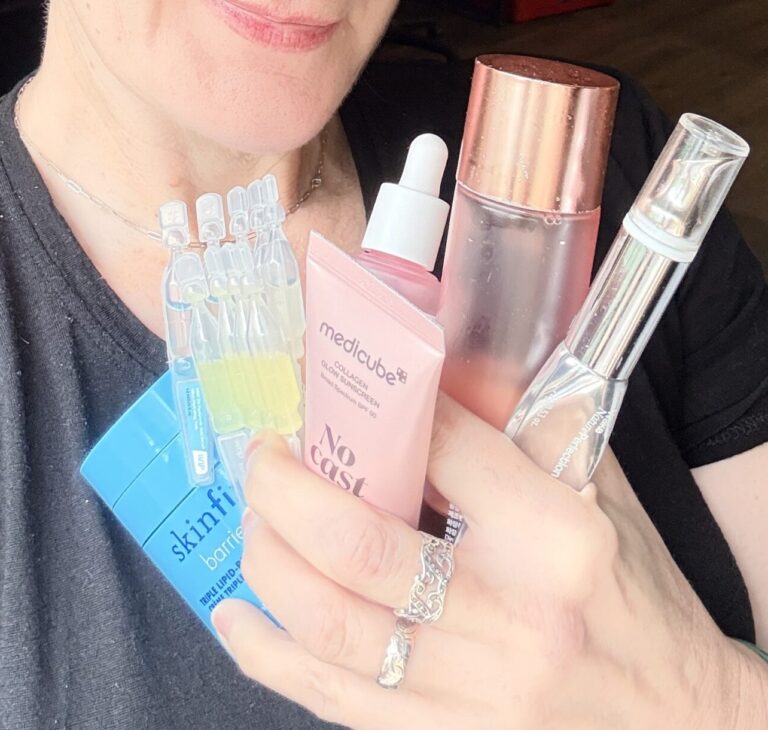
So what do I actually do? When we go to the ocean, I use mineral sunscreen on my body, every time. At the pool, I use my favorite kbeauty SPF’s on my face (Round Lab & medicube Collagen SPF – because they are skincare), mineral sunscreen on the rest of me. I’m still experimenting with finding the best one for my skin. I’ve tried so many, including beef tallow SPF with zinc.
Shawn, meanwhile, wears no sunscreen at all unless I physically hand it to him and make him apply it to his shoulders, nose, and cheeks. We”ll come back to him.
What Finally Calmed My Dermatitis and Rosacea
For years, the answers I got made things worse.
Dermatologists gave me prescription after prescription. Some did nothing. Some made my skin angrier than it was to start. The big recommendation was always a drugstore standby, like CeraVe, which dried me out even more. I started to believe the dermatitis was just mine to carry. Something I’d manage with green-tinted moisturizer to hide the rosacea redness and a lot of quiet frustration.
Then at 50, I fell into TikTok Shop almost by accident and brands started sending me skincare to try. That’s where I found K-beauty.
The medicube glass skin set changed everything for me. My dermatitis cleared in a month. After 30 years of dealing with it as an adult, less than 30 days of trying a free sample, and I was not only dermatitis-free but also had visibly fuller, more radiant skin. It’s now been two full years without a single dry patch anywhere on my face.
Rosacea is a different animal. Rosacea doesn’t go away, and I won’t tell you it does. But mine no longer gets activated the way it used to. My skin runs calm now. I stopped reaching for the green-tinted moisturizer because I no longer need to cancel out redness that is not flaring anymore.
What cleared my skin might do nothing for yours. Sometimes we don’t need another prescription. We need knowledge and a willingness to try things until we find what our own specific skin responds to. No single product works for every face. Anyone who tells you otherwise is selling something.
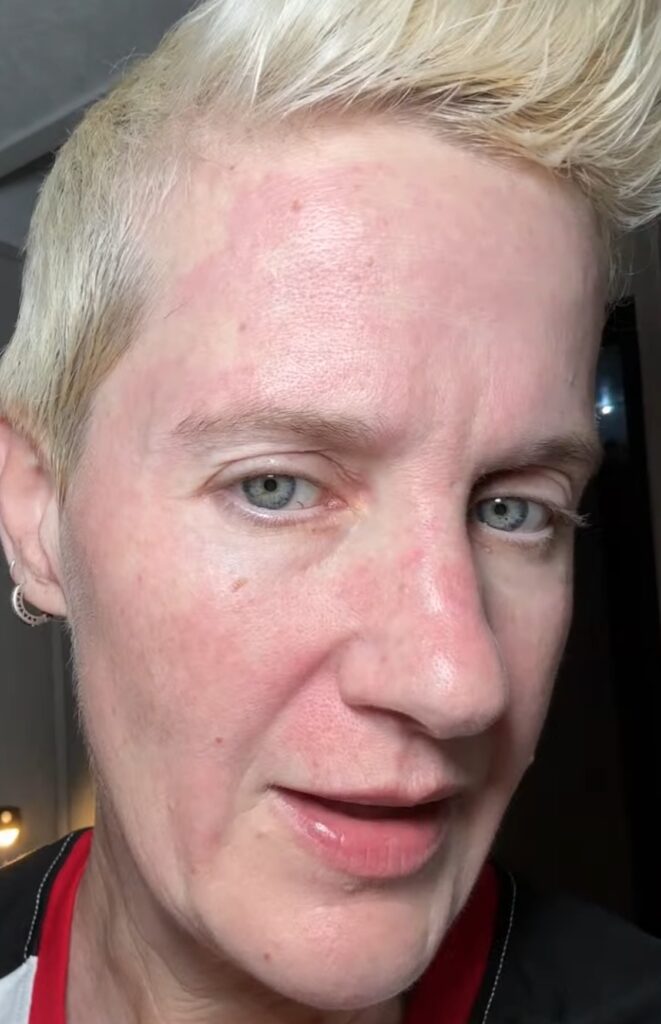
My Skincare Routine, Morning and Night
Women are constantly stopping me to compliment my skin and ask what products I use. I’ve been sent skincare products to try by some of the world’s top beauty brands over the past 2 years as a content creator. I never give good reviews if I don’t like the product, and I never give a skincare review without first trying it for at least a full week. In fact, if I don’t like a product, I’ll make a video about it.
Even after learning about skincare products and anti-aging, hydrating, and just what to put on your skin and in what order, I still wasn’t really paying attention to ingredients other than the focus selling points because I didn’t really know what I was talking about.
I started deep-reading the brand selling briefs and researching ingredients on my own, and seeing things like Phthalate-, Paraben-, & Sulfate-Free. Phthalates are endocrine disruptors used to make plastics more flexible. They are also linked to reproductive issues. Parabens are preservatives added to cosmetics so they don’t grow bacteria and mold, but they are hormone disrupters and can mimic estrogen and increase your risk of breast cancer. And sulfates? They are the least worrisome of this trifecta. They are used in cleaners to create a foam and can strip your skin. So if you have eczema or other dry or sensitive skin issues, you need to avoid them.
I also learned about Alcohol and Synthetic fragrances added to our skincare products that create other problems. Which then led me down a path to why even using perfumes can be toxic. I even saw some products had formaldehyde releasers. It immediately made me think of my science class in the 80’s and the jars of formaldehyde and the animals to dissect. And, formaldehyde is a known carcinogen? Why are companies putting these types of ingredients in products for us to use on our skin and for our children?
So, now I make sure that any product my family uses is Phthalate, Paraben, Sulfate and formaldehyde-free. I’m still into my fragrances for now. I love my Tom Ford Tobacco Vanille.
I’m pretty lazy about my skincare, or at least I was. So, for me to be consistent and do what I need to do each morning, I keep it simple. Cleanse, treat, protect.
Also, I don’t usually wear any makeup beyond lipstick daily. I will use mascara and some eye makeup, but I don’t use foundation or contour or anything to cover up my freckles. So I need my skincare routine to make my natural skin glow. My routine is built around defending my skin for the day, and it ends with SPF any day I leave the house. These are all the skincare products I use every single morning, and in the order I use them. Most are super affordable, all are free of the nasty stuff above, and all work for my sensitive, rosacea- and dermatitis-prone skin. So if you are looking for some products to try, check them out.
Nights are where I do the real work. A deeper cleanse, jelly or mud masks, retinol, a few nights a week, and this is where my skincare devices come in. These are the products I use for my evening skincare routine. I don’t use the LED masks and devices every single night, but I do incorporate them a few nights a week.
The devices are a topic in their own right. Some have earned their spot on my counter. Some were a waste of money. I use products with Near Infrared LED and multiple light color options along with EMS, Cryo, Massage, and more.
Beauty Is an Inside Job Too
The same hormone drop that changed my skin is the reason my hair thinned and my nails got brittle. That is not a coincidence. It’s one body, sending the same signal in three places. So when I work on my skin, I work on the inside, too.
Protein matters more now than it ever did for your skin, your hair, and your nails, and how much each individual person needs. Collagen is part of that picture, too, and the change it made to my nails and hair, specifically, surprised me once I figured out the right daily dosage. And if your skin is acting up no matter what you put on top of it, it is worth looking down at your gut, because the signs of poor gut health after 50 often show up on your face first.
Inside and outside. Don’t forget it. The skin serums and the protein are on the same team.
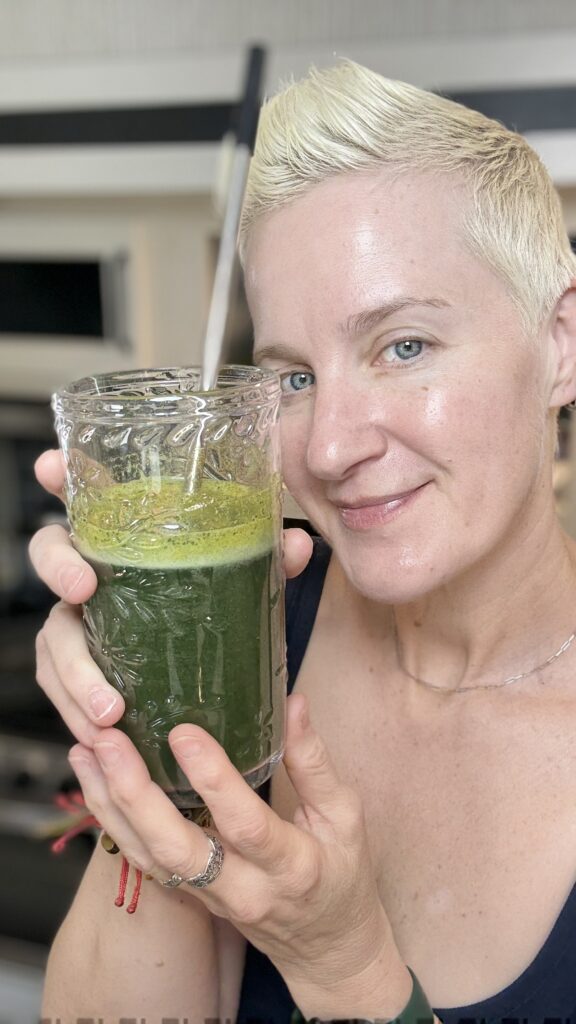
My 56-Year-old husband does nothing and still looks young
I have to tell you about my husband, because he is living proof that none of this is one-size-fits-all.
Shawn is 56 and even lazier about skincare in a way that would be impressive if it were not so annoying. He washes his hair, face & body with a bar of soap. It’s either Dove unscented beauty bar or a natural or handmade soap like Pacha Soap. Then, he only uses Aveeno Lotion. That’s his entire routine and as fancy as he gets.
I’ve tried telling him about how the alcohol in his lotion dries him out but he swears it’s the only lotion that he likes using. Period. And, he only moisturizes his face and neck. He ignores his dry, ashy legs and the rest of his body completely, no matter how many times I bring it up, unless I offer to put it on for him – like a typical guy.
And he doesn’t look his age either.
I’ve actually tried to use just Dove soap or his Pacha, but it absolutely didn’t work for my face. I have to use a good number of products to make my skin look this way. I could be irritated about it, but instead, I let it make my point for me. His skin and my skin are not the same skin, and they never will be. What his face tolerates would wreck mine. That’s exactly why I want you to try different things. I want you to read your own skin the way I finally learned to read mine.

Your Environment plays a part
When we are in warm, humid places around the world, my skin glows. Even if I’m not using my skincare products daily, my skin looks dewy, fuller, and more youthful. Shawn’s skin looks good, too, but the heat makes him want to shower multiple times a day, which dries it out. Not me. I’ll take a shower every couple of days.
When we’re in cold and wintry conditions, my skin is NOT happy. I’m dry. I get dandruff. My dermatitis and rosacea are begging for moisturization and even warmth. Shawn’s skin gets drier too
When we hop from climate to climate as full-time travelers, our skin takes a bit of time to adjust, which can feel and look uncomfortable.
We were just in Phoenix, Arizona, in March, and there was a massive heat spike over 100°F. If you aren’t aware, they have dry heat. Our skin was so dry, and we felt like the crypt keeper. No matter how much sea salt water or moisturizers we used, we saw scales. The insides of our noses were dried up, too, and we each had bloody noses, and our allergies were killing us. We were really struggling with the dry heat.
We even notice that going from using AC to no AC dries us out, too.
So if your skin is struggling no matter what you do, maybe it’s where you live.
The Bottom Line on Skincare as you age
When you age, your skin is drier, thinner, and more reactive, so the products that worked for years may be working against you now. The fix is two-sided. Pay attention to what you put on your skin, start reading labels, and support it from the inside with protein, collagen, and gut health. There is no single magic product. There is your skin, and the willingness to figure out what it needs.
If I’ h’d known in my 20s how much this would matter later, I hope I would have taken better care of my skin back then. I didn’t. But the thing about skin is that it responds to what you do for it now, at any age. So I started now. You can too.
Frequently Asked Questions
Does my skincare routine need to change after 50?
Yes. After 50, lower estrogen thins the skin, reduces oil, and weakens the barrier, so skin gets drier and more easily irritated. Products and actives you tolerated for years can start to sting, dry you out, or trigger redness, which is why many people need to simplify and switch to gentler formulas.
What skincare ingredients should I avoid?
Many people choose to avoid added synthetic fragrance, which can irritate sensitive skin, along with parabens and phthalates, which are flagged as hormone-disrupting and can be absorbed through the skin. The most useful habit is not memorizing a banned list, it is turning the bottle over and reading the ingredients the same way you would read a food label.
Can you clear rosacea or dermatitis?
Rosacea is a chronic condition with no cure, but it can often be calmed and kept from flaring with the right gentle routine and trigger avoidance. Dermatitis can improve significantly with the right products for your skin. In my own case, switching to gentler K-beauty products cleared my dermatitis and calmed my rosacea, but everyone’s skin is different, so what worked for me is a starting point, not a guarantee.
Is mineral or chemical sunscreen better?
Both protect from UV, but they work differently. Mineral sunscreens use zinc oxide or titanium dioxide to sit on top of the skin, while chemical filters like oxybenzone absorb into the skin, and the FDA has found that these filters enter the bloodstream. Mineral formulas are also the ones recognized as reef-safe. Many people over 50 with sensitive skin find mineral options gentler.
Do LED masks and skincare devices actually work
Some do, and some don’t, and the price tag does not always tell you which. LED and EMS devices can be a useful part of a routine, but results vary by device and by person, and consistency matters more than any single gadget. The honest answer is to learn which specific tools are worth it before spending, rather than buying the most expensive one and hoping. And, when you are looking at reviews, look at them from those who are your age, not the 20-30-something creators who haven’t started menopause or lost elasticity or understand thinning skin.
Disclosure: This post contains affiliate links. If you purchase through our links we may earn a small commission at no extra cost to you. We only recommend products Wendy personally uses and believes in. Read our full Affiliate Disclosure here.
Disclosure: GutBeautyBody content is written from personal experience and research. We are not medical professionals. All factual health claims are sourced from peer-reviewed research and reputable health organizations. Read our full Medical Disclosure here.