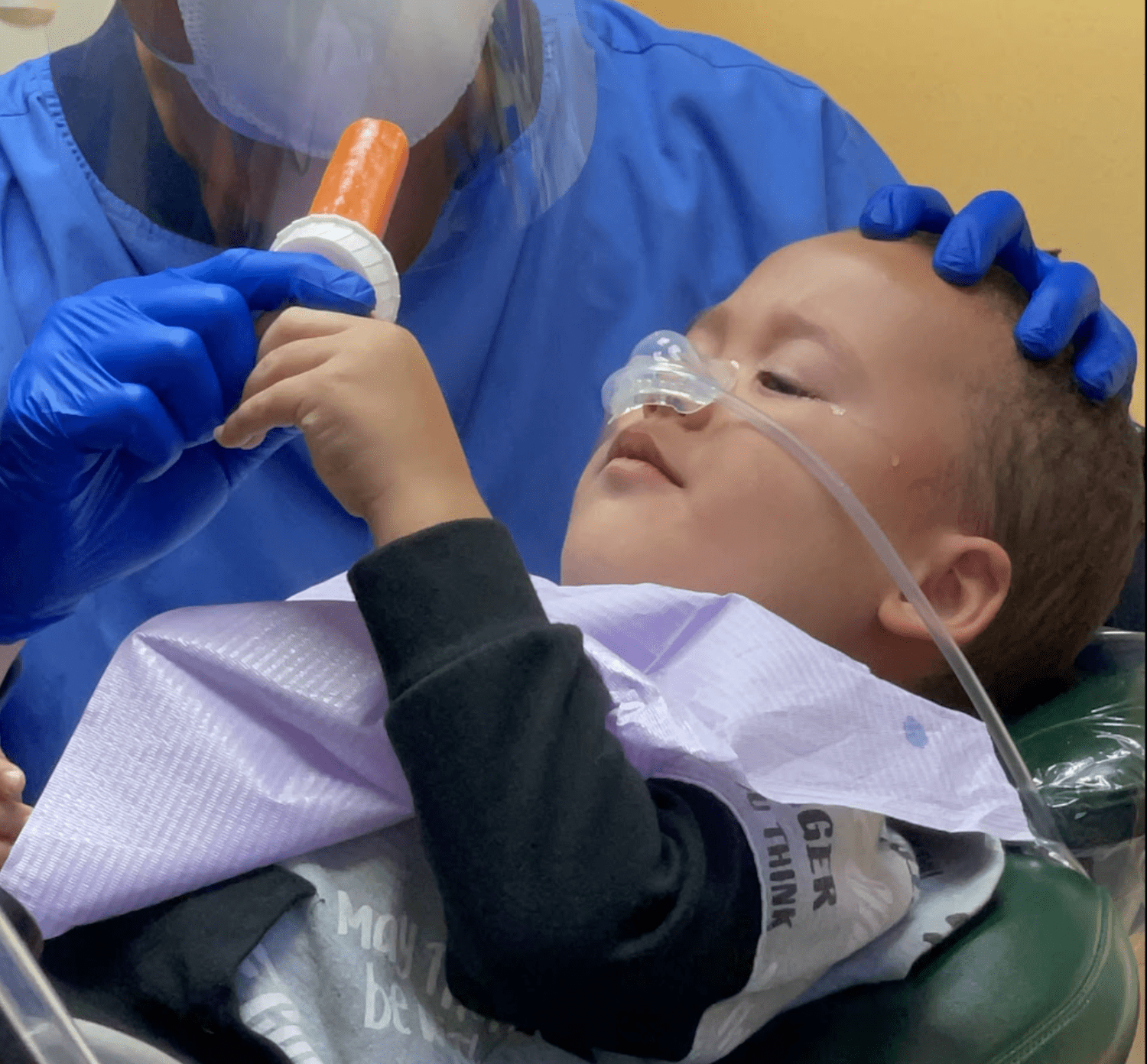
When our youngest son, Sebastian, was three, the dentist found two of his molars had cavities so deep that they had cracked his teeth. They needed to be pulled.
I brushed his teeth religiously every morning and night. I flossed his teeth. I used the toothpaste the dentist recommended. I did everything I was told to do.
And it still happened.
That experience, and the dental visits that followed, are something Sebastian still struggles with five years later at age eight. He has a deep-rooted fear of dentists and even Doctors because of it. We have to make initial hangout-style meet-and-greet appointments where no dental work is done. He gets to ask questions and feel comfortable, and then we make a follow-up appointment. It’s always stressful for him, as well as me.
This entire situation changed how I think about dental care, what I put in my family’s mouths, and why I eventually switched to fluoride-free toothpaste.
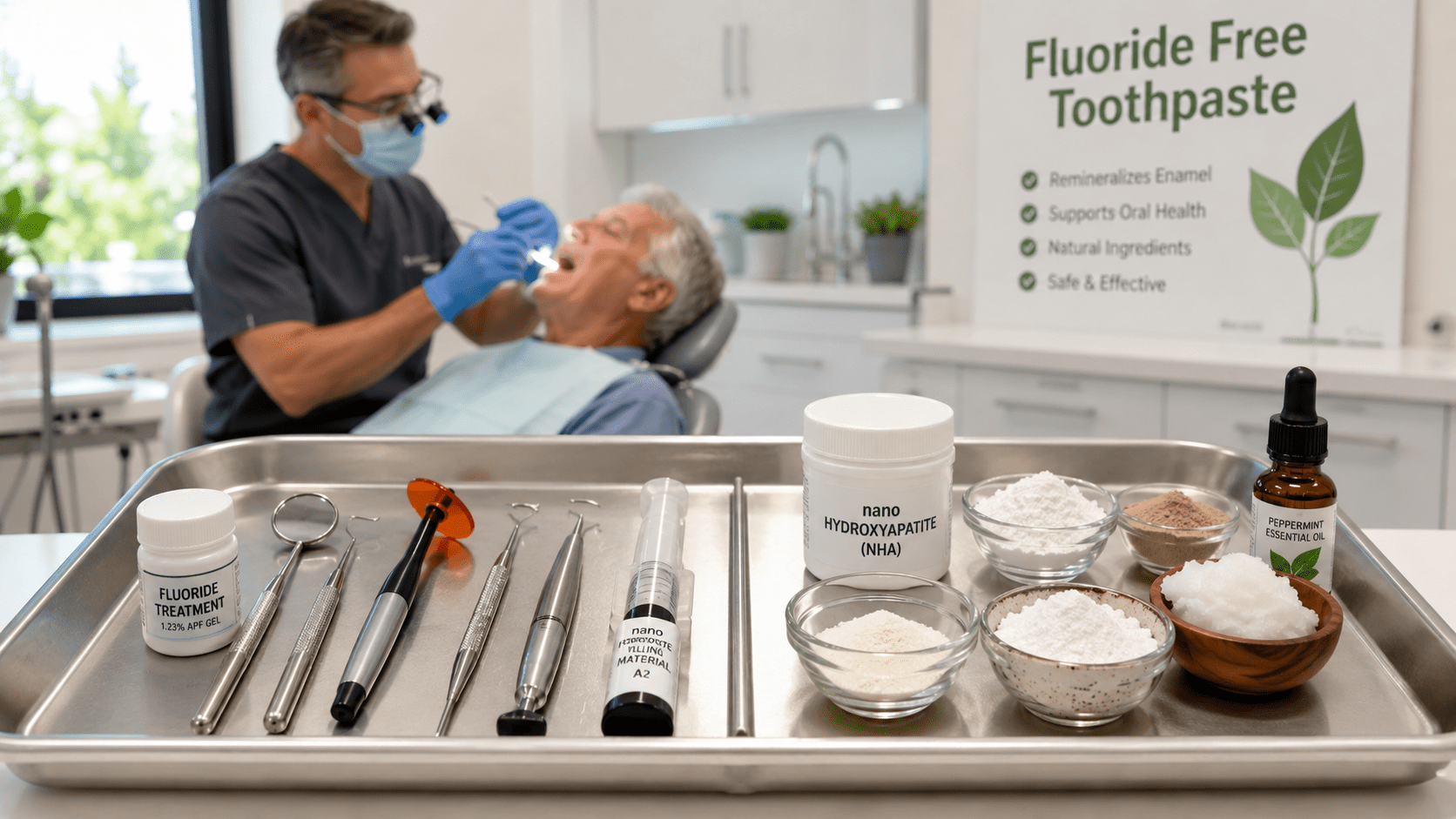
Fluoride-free toothpaste using nano-hydroxyapatite has been shown in clinical trials to be equally effective as fluoride toothpaste for cavity prevention, and it works by depositing the same mineral your teeth are already made of directly into weakened enamel.
Disclosure: This post contains affiliate links. If you purchase through our links we may earn a small commission at no extra cost to you. We only recommend products Wendy personally uses and believes in. Read our full Affiliate Disclosure here.
How Fluoride Became the Standard
To understand why we switched to fluoride-free toothpaste, it helps to understand how fluoride ended up in your toothpaste and your water in the first place.
In the early 1900s, a dentist in Colorado Springs noticed something strange. Residents had brown-stained teeth, but almost no cavities. After decades of research, scientists figured out that naturally occurring fluoride in the local water supply was responsible for both the staining and the cavity protection.
In 1945, Grand Rapids, Michigan became the first city in the U.S. to add fluoride to its public water supply. Within a decade, cavity rates in children dropped by 60 to 65 percent. Crest introduced the first fluoride toothpaste in 1955. The CDC named water fluoridation one of the top ten public health achievements of the 20th century.
So fluoride worked. That part is real.
The question is whether it’s still the only option, whether the amount we’re exposed to now is too much, and whether there are alternatives that work just as well without the concerns that have started piling up. And also begs the question, why are people still getting so many cavities, yellow teeth, and dental decay?
Where the Concerns Come In
According to the Yale School of Public Health, while fluoride prevents cavities, prolonged exposure to high levels can damage teeth and bones. Recent evidence also suggests that moderate levels of fluoride may be linked to lower IQ in children. A meta-analysis from Harvard combined 27 studies and found strong indications that fluoride may adversely affect cognitive development in children.
Here is what made me start paying attention.
If you drink tap water in most U.S. cities, you are already getting fluoride. Over 200 million Americans receive fluoridated water from their public water system. Then you brush with fluoride toothpaste twice a day. Maybe you use a fluoride mouthwash too. Your kids are doing the same thing.
At what point is it too much? And has anyone actually looked at the total amount of fluoride your family is consuming from all sources combined?
That’s the question that sent me down the rabbit hole. And once I started looking at what was actually in our toothpaste, I found more than just fluoride to be concerned about.
What Else Is In Your Toothpaste
A few years ago, dental hygienists across the country started finding tiny blue specks embedded in their patients’ gum lines. At first nobody could figure out what they were. Turned out they were polyethylene microbeads, the same plastic used to make grocery bags and water bottles, and they were coming from toothpaste.
Crest’s whitening and Pro-Health lines contained these beads. They served zero dental purpose. They were purely decorative. But they were getting trapped in the gums, attracting bacteria, and creating the potential for inflammation, gingivitis, and periodontal disease.
The issue got big enough that Congress stepped in. President Obama signed the Microbead-Free Waters Act in 2015, and manufacturing of toothpaste containing microbeads was banned by July 2018.
Plastic in toothpaste that served no purpose, got stuck in your gums, and had to be banned by federal law. That happened. And most people had no idea because they never read the ingredients on their toothpaste, and if they did, they had no idea what it was.
What else is in there that you haven’t looked at?
What is Nano-Hydroxyapatite?
Your teeth are made of a mineral called hydroxyapatite. It’s the primary building block of your enamel and your bones. When your enamel weakens from acid, sugar, or bacteria, it loses those minerals. That process is called demineralization.
The reverse, when minerals are deposited back into weakened enamel, is called remineralization. Your saliva does this naturally to some degree. But it can only do so much.
Fluoride helps remineralization by forming a harder layer on the enamel surface. Nano-hydroxyapatite, or n-HA, does it differently. It deposits the same mineral your teeth are already made of directly into the weak spots. It fills microscopic cracks, bonds to the enamel surface, and rebuilds what was lost.
An 18-month clinical trial published in Frontiers in Public Health found that fluoride-free toothpaste containing hydroxyapatite was equally effective as fluoride toothpaste for cavity prevention. According to GoodRx, n-HA mimics the natural structure of your teeth more closely than fluoride, and unlike fluoride, it’s safe if swallowed, which matters when your kid is three years old and still learning not to eat the toothpaste.
It’s important to understand that remineralization works on early-stage enamel damage. Once a cavity has formed all the way through the enamel into the dentin, no toothpaste is going to fix that. You need a dentist. This isn’t about avoiding the dentist. It’s about what you use every single day between visits.
What I Made in My Kitchen
After I was told that we had to pull Sebastian’s teeth, I started researching. I decided to stop using fluoride toothpaste for our family and try something different.
I bought all the powders needed to make my own fluoride-free toothpaste / toothpowder, and the directions all required food-grade versions of calcium carbonate, baking soda, fine Celtic or Himalayan sea salt, bentonite clay, and even extracts or xylitol to flavor and sweeten the powder. I mixed my own toothpaste powder at home
In the end, Sebastian and I loved the cleaning power and texture of the unflavored powder. We used it for a couple of years. And Sebastian has not had a cavity since we made the switch.
This is the crazy part, though. His dentist at the time had recommended fillings for early-stage cavities on some of his other teeth. After we switched to the homemade powder, those early-stage cavities reversed. The damage that was starting on his other teeth stopped progressing, and the enamel began to remineralize. The dentist said the fillings were no longer necessary.
One thing I want to be clear about. Switching to a fluoride-free toothpaste or making your own powder is not a substitute for going to the dentist. We still go regularly. Sebastian still goes regularly. The difference is that, between visits, we’re using something that actively supports remineralization instead of just relying on fluoride to do a job other ingredients can do without the concerns that come with it, especially for kids and women over 50 whose enamel is already thinning.
Finding the Right Fluoride-Free Toothpaste
When we started traveling again, I couldn’t find all the ingredients I needed to keep making our toothpowder. We were overseas, and sourcing food-grade baking powder in Southeast Asia is a lot harder than you’d think.
So I started searching online for a fluoride-free toothpaste that could be shipped to me anywhere. I tried several brands. Most of them tasted terrible, had the wrong texture, or foamed way too much.
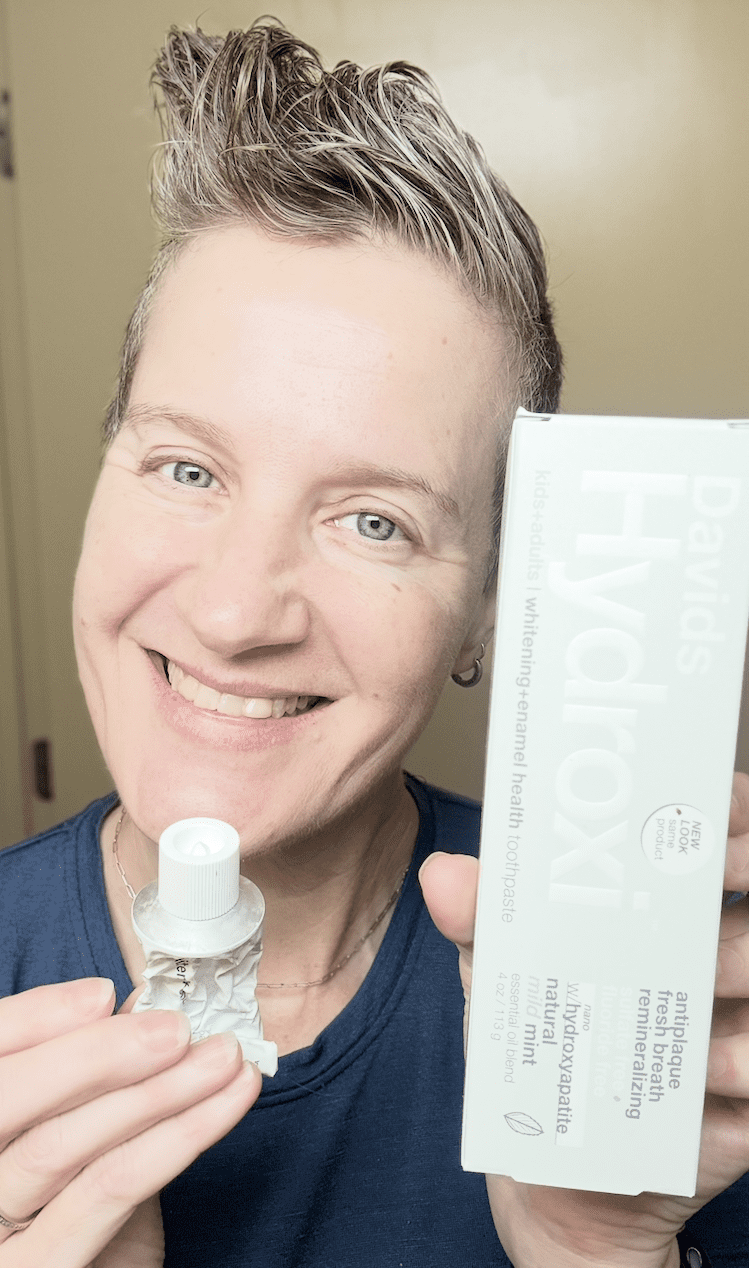
Then we found Davids Hydroxi. They use a nano-hydroxyapatite formula they call Hydroxi instead of fluoride. The flavor is right. The ingredients are right. The texture and foam are what we were looking for. The whole family uses it now, including Shawn, who has sensitive teeth and loves it.
I’m not saying this is the only fluoride-free toothpaste that works. I’m saying it’s the one that worked for us after trying a lot that didn’t. Look at the ingredients in whatever brand you’re considering. Make sure it uses nano-hydroxyapatite. Make sure you know what else is in there. Read the label the same way you’d read a food label.
Why This Matters Even More After 50
I started this whole journey because of my kid. But at 52, I’m realizing it matters even more for me now than it did then.
According to Harvard Health, older adults suffer higher rates of gum disease, dental decay, oral cancer, and tooth loss. The average age people get their first set of dentures is between 40 and 49. About 15 percent of adults 65 and older have lost all of their natural teeth.
Teeth weaken as you age. Gums recede. Enamel thins. Dry mouth from medications makes everything worse because saliva is your body’s natural remineralization system. When saliva production drops, your teeth lose one of their main defenses.
What you brush with every day for 30 or 40 or 50 years matters more than most people think. If you’ve been using the same toothpaste since college and never once looked at the ingredients, now is a good time to start.
Your teeth don’t exist in isolation from the rest of your health. Poor dental health after 50 is connected to gut health because digestion starts in your mouth. It’s connected to nutrition because if chewing hurts, you start avoiding the foods your body actually needs. It’s connected to sleep because dental pain and gum inflammation can disrupt sleep quality. It’s connected to energy because chronic low-grade infections in your gums drain your body’s resources without you even realizing it. Choosing a fluoride-free toothpaste was a dental decision for us, but the ripple effects touched almost every part of how we feel day to day after 50.
The Miswak, and Why I’m ordering one
While I was researching all of this, I came across something that fascinated me.
In parts of Africa, the Middle East, and Asia, people have been cleaning their teeth with a chewing stick called a miswak for centuries. It comes from the Salvadora persica tree. The World Health Organization recommends it as an effective oral hygiene tool. Research shows it reduces plaque and gum inflammation at levels comparable to a regular toothbrush.
Some of the healthiest, whitest teeth in the world belong to people who have never touched a tube of toothpaste. That’s not a sales pitch. It’s just a fact that made me think about how much of what we consider normal is really just marketing we grew up with.
I ordered one. I have no idea if I’ll like it. I have no idea if it will feel weird or taste like a tree branch or become my new favorite thing. But I’m going to try it, and I’ll report back with an honest review. Because that’s what this whole site is about. Trying things, sharing what happens, and letting you decide for yourself.
What You Should Be Asking Right Now
Do you know what’s in your toothpaste? Not the brand name on the front. The actual ingredients on the back.
Do you know what’s in your kids’ toothpaste?
Do you drink tap water? There’s already fluoride in that. So do you also need it in your toothpaste? And your mouthwash? And your kids’ toothpaste on top of that?
Do you know what remineralization means and whether your current toothpaste actually supports it?
I didn’t know until I was forced to ask, why. If you’re over 50, add these to the list.
Has your dentist talked to you about how medication-related dry mouth affects your enamel?
Have you noticed your gums receding and wondered whether your toothpaste is helping or just maintaining the damage?
Have you considered that the fluoride-free toothpaste options available now didn’t exist ten years ago, and the research supporting them has changed significantly?
Science has moved. The question is whether your bathroom cabinet has moved with it.
You don’t have to switch to the same fluoride free toothpaste we use. You don’t have to make your own powder. You don’t have to do anything.
But read the ingredients. Ask your dentist real questions. Look up what nano-hydroxyapatite is and what the research says. And then decide for yourself what makes sense for your family.
That’s all I ever ask.
Disclosure: GutBeautyBody content is written from personal experience and research. We are not medical professionals. All factual health claims are sourced from peer-reviewed research and reputable health organizations. Read our full Medical Disclosure here.
Disclosure: This post contains affiliate links. If you purchase through our links we may earn a small commission at no extra cost to you. We only recommend products Wendy personally uses and believes in. Read our full Affiliate Disclosure here.