
Disclosure: This post contains affiliate links. If you purchase through our links we may earn a small commission at no extra cost to you. We only recommend products Wendy personally uses and believes in. Read our full Affiliate Disclosure here.
I’ve tried every form of magnesium there is. Glycinate, citrate, malate, L-Threonate, oxide, taurate, powders, oil, flakes, lotions, and even soaking my feet in it.
My favorite is glycinate because I can feel it relaxing my muscles and helps with anxiety when I need it. It is also the form most people reach for first when they start looking into magnesium for sleep, even before they realize how many other forms exist.
What it has never done, though, is put me to sleep.

What Magnesium Actually Does in the Body
Magnesium is involved in more than 300 chemical reactions in your body. It helps regulate muscle and nerve function, supports a steady heartbeat, keeps bones strong, and plays a role in how your body produces energy. Most adults need somewhere around 310 to 420 milligrams a day, depending on age and sex, and a large share of adults don’t consistently get enough of it from food alone.
Magnesium deficiency can show up as muscle cramping, tension, and restlessness, the exact things that can keep you from settling into sleep in the first place. Replacing what you’re missing can help. It is just not the same thing as magnesium being a sleep aid on its own.
The Different Types of Magnesium, and What Each One Is Actually For
Magnesium oxide is poorly absorbed by the body compared to other forms, which is exactly why it works so well as a laxative. If your goal is digestion and clearing your bowels, this is the one for you. If your goal is sleep, it is the wrong choice, and it will likely just send you to the bathroom instead.
Magnesium citrate absorbs better than oxide and is one of the most common forms sold. It still carries a real laxative effect for a lot of people, but some research has also looked at it specifically as a sleep aid, separate from its digestive reputation.

Magnesium glycinate is magnesium bound to glycine, an amino acid that itself has a calming effect on the nervous system. This combination is why glycinate is the form most associated with muscle relaxation, nerve support, and easing physical tension, without the laxative effect that comes with citrate or oxide. This is exactly why it is the one I keep coming back to.
Magnesium taurate is bound to taurine and is the form most studied for cardiovascular and heart health specifically, which is worth knowing if heart health is part of why you are looking at magnesium in the first place.
Magnesium L-threonate is one of the newer forms on the market, and it’s the one most associated with crossing into the brain itself, with research focusing on memory and cognitive function rather than sleep or muscle relaxation.
Magnesium malate is paired with malic acid, which plays a role in how your cells produce energy, and it tends to get used more for muscle recovery and fatigue than for sleep.
None of these forms does the same job. Picking one based on what worked for a friend, without knowing what that friend was actually trying to fix, is how people end up disappointed, especially when the goal was magnesium for sleep specifically, and they ended up with a laxative instead.
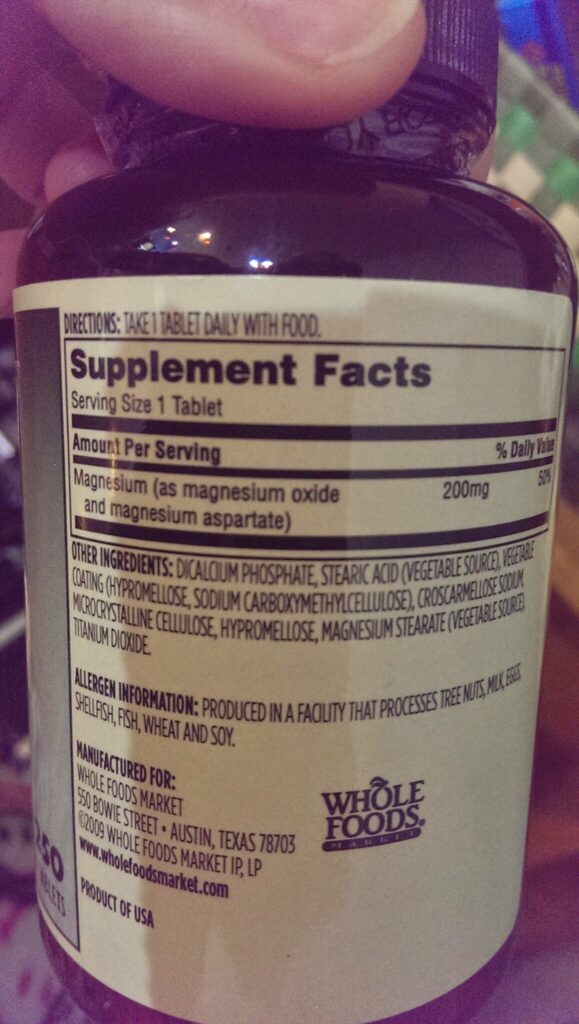
Most magnesium you’ll find on the shelf just says magnesium. You need to look at the label on the back to see exactly what kind you are getting. Before I understood that there were different types of magnesium, I only knew that it helped you poop. This magnesium bottle from Whole Foods and the fillers. Pay attention to the fillers.
Does Magnesium for Sleep Actually Work?
Magnesium for sleep doesn’t work the same way for everyone. Research shows mixed results, with some people experiencing real improvements in how quickly they fall asleep or how well they stay asleep, while others notice little to no difference.
That gap between what works for one person and what works for another is the point. For me, magnesium citrate wakes me in the middle of the night to poop. So it causes the exact opposite effect of what I want.
Researchers have been studying magnesium and sleep for years, and one integrative medicine physician put it plainly, the evidence is still thin. A major review of the existing studies found something similar. Observational research suggested a connection between magnesium levels and sleep quality, but the more rigorous randomized trials came back with contradictory results, and there are not enough high quality studies to recommend magnesium as a routine sleep aid, even though some people genuinely do sleep better on it.
Magnesium is thought to support GABA, a neurotransmitter that calms nerve activity, and it also plays a role in how the body produces melatonin, the hormone that helps regulate when you feel sleepy. That is the theory behind why magnesium might help. Whether it delivers that effect for you personally is a different question, and the research so far cannot answer that for everyone at once.
Why Glycinate Works for My Body, Even Though It’s Not What Puts Me to Sleep
Glycinate is the form most often cited for relaxation and muscle support, and that aligns exactly with how I feel from it. My muscles loosen, the tension I am carrying drops, and I physically unwind in a way that is real and noticeable every time I take it for short periods.
Citrate has the most evidence behind it, specifically as a sleep aid in some research, which is part of why I think of citrate as the sleep-leaning form and glycinate as the muscle and tension form, even though that line is not as clean in the research as it feels in practice. The laxative effect that comes with citrate is the obvious tradeoff, and it is not exactly what you want working against you at 2am.
What This Has Actually Looked Like for Us
I keep Pure Encapsulations magnesium glycinate on hand, and it is my favorite brand across all the magnesium forms I rotate through. No fillers. High Absorption. And a brand that you can trust.
Glycinate relaxes my body every time I take it, but it has never actually put me to sleep. For me, the muscle relaxation and the sleep itself turned out to be two completely separate problems, and I needed to stop expecting one supplement to solve both.
My daughter uses magnesium citrate powder when she needs help winding down, and for her, it works. She takes it before bed and it noticeably helps her fall asleep, which is exactly the kind of individual difference the research keeps pointing to.
Shawn takes magnesium glycinate too, but not for sleep at all. He uses it occasionally for his legs, when cramping flares up, and that is the only reason it is in his routine. He also uses either citrate or oxide for bowel movements when he’s bound up
Three people in the same family, three completely different relationships with the same mineral.
Why I Don’t Rely on Any Supplement Long Term for Sleep
I don’t think any supplement should be the long-term answer for sleep, magnesium included – unless you have a deficiency.
A consistent sleep routine actually moves the needle more than anything you take, and that’s held true for me even after working through every form of magnesium on the shelf. Magnesium can be part of the picture. It is not the whole picture, and treating it like the fix is how people end up frustrated and still tired.

What This Comes Down To
Magnesium for sleep isn’t one-size-fits-all, and the type you choose matters as much as whether you take it at all. Oxide supports digestion. Citrate leans toward both sleep and digestion, with a laxative trade-off. Glycinate supports muscle relaxation and a calm nervous system without that tradeoff. Taurate is the one worth knowing about for heart health. For us, that has meant glycinate for relaxation, citrate specifically for my daughter’s sleep, and magnesium for leg cramps for my husband; and oxide for bowel assistance.
Frequently Asked Questions
Does magnesium actually help you fall asleep?
Research is mixed. Some people experience real improvement in how quickly they fall asleep and how well they stay asleep, while others notice little to no difference. Individual response varies significantly.
Which type of magnesium is better for sleep, glycinate or citrate?
Glycinate is generally considered gentler and more calming due to its glycine content, making it a common choice for relaxation and sleep without a laxative effect. Citrate has more direct evidence as a sleep aid in some studies, but its laxative effect can be disruptive for certain people.
Why does magnesium relax my muscles but not help me sleep?
Magnesium plays a documented role in muscle relaxation and nervous system calming, which are different mechanisms than what is required to initiate or maintain sleep. It is possible to feel physically relaxed without that translating into falling or staying asleep.
What is magnesium oxide used for if not sleep?
Magnesium oxide is poorly absorbed compared to other forms, which makes it more useful as a laxative for occasional constipation than as a sleep or relaxation aid.
Is it safe to take magnesium for sleep long term?
Magnesium is generally considered low risk for most people, but it is not established as a guaranteed long-term sleep solution. Building consistent sleep habits is more reliably linked to improved sleep than any single supplement.
Disclosure: GutBeautyBody content is written from personal experience and research. We are not medical professionals. All factual health claims are sourced from peer-reviewed research and reputable health organizations. Read our full Medical Disclosure here.
Disclosure: This post contains affiliate links. If you purchase through our links we may earn a small commission at no extra cost to you. We only recommend products Wendy personally uses and believes in. Read our full Affiliate Disclosure here.