Disclosure: This post contains affiliate links. If you purchase through our links we may earn a small commission at no extra cost to you. We only recommend products Wendy personally uses and believes in. Read our full Affiliate Disclosure here.
I had my gallbladder taken out in 2002, and I also had RNY gastric bypass surgery in 2006. So when people ask me if digestive enzymes actually work or if I have dumping syndrome, I don’t have a simple answer. I have two different supplements, two different reasons, and a lot of trial and error to get here.
Do Digestive Enzymes Actually Work or Am I Wasting My Money?
In 2001, I’d just had our 2nd child, and a couple of weeks later, I had my first gallbladder attack. They would come and go off and on since he was born. I didn’t know it was my gallbladder and just thought maybe I was still recovering from postpartum pain. I would have stabbing pain in my back below my shoulder blades that would come and go every few days, and it was more painful than childbirth. My doctor ran tests and told me it was indigestion. Seriously?
When Sam was 3 months old, I had another episode, but this time I almost dropped him as I fell to my knees in pain. We went straight to the ER, where they found a blockage in my gallbladder. I was immediately set for laparoscopic surgery.
For the next 6 months, as my body adjusted to its new system, if I ate or drank anything, I would need to be near a toilet for the next 20 minutes. I had no idea about digestive enzymes or anything else that could help me. I struggled for many years after both surgeries with needing to be near a toilet.
For most healthy adults, daily digestive enzyme supplements have limited proven benefit. But for specific situations, such as no gallbladder, fat malabsorption, or a heavy, greasy meal, they can genuinely reduce bloating and gas and give you a better quality of life – away from the toilet. The honest answer is it depends on why you’re taking them, not whether they work in general.
That’s not the answer most supplement companies want you to hear. A lot of digestive enzyme marketing treats every body the same. CNN’s coverage of this, talking to actual dietitians and doctors, makes the same point I’m about to make. Enzymes aren’t a daily fix-all. They’re a tool for specific jobs.
I don’t take them every day. I take them when I have a reason to.
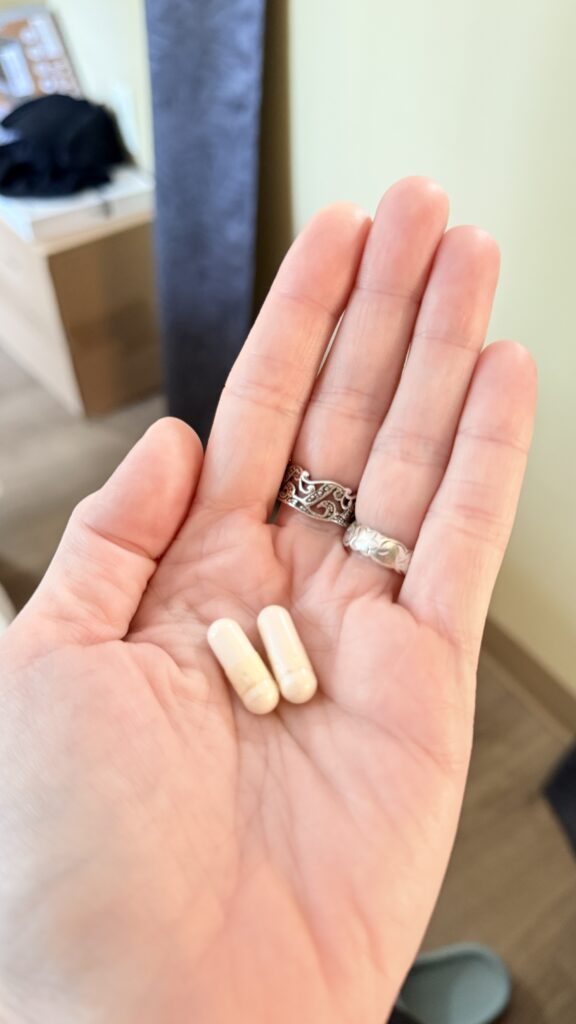
What Changes When You Don’t Have a Gallbladder
Your gallbladder doesn’t make bile; that’s your liver’s job. The gallbladder’s job is storage. It holds bile and releases it in a concentrated burst when fat enters your system, so your body has enough on hand when you actually need it.
Take the gallbladder out, and the liver keeps making bile. It just doesn’t have anywhere to hold it. Bile drips out slowly and constantly instead of arriving in that concentrated wave. Eat something light, no real problem. Eat something heavy in fat, and there isn’t enough bile on hand at the right moment to break it down. That’s when the cramping, the gas, the bloating show up.
This is also where gastric bypass complicates things further for me specifically. With Roux-en-Y surgery, food moves from a small stomach pouch straight into the small intestine, faster than a typical digestive system. When sugar and fat hit that fast, in something like ice cream, you end up experiencing dumping syndrome. Food moves too fast, my body reacts, and I pay for it in cramping and gas if I’m not careful. My family pays for it, too, with the gas they have to suffer through.
Two surgeries, two different reasons my digestion doesn’t work the way it used to. That’s why I don’t take one thing. I take two.
What I Actually Take and Why
I use two different products because they solve two different problems.
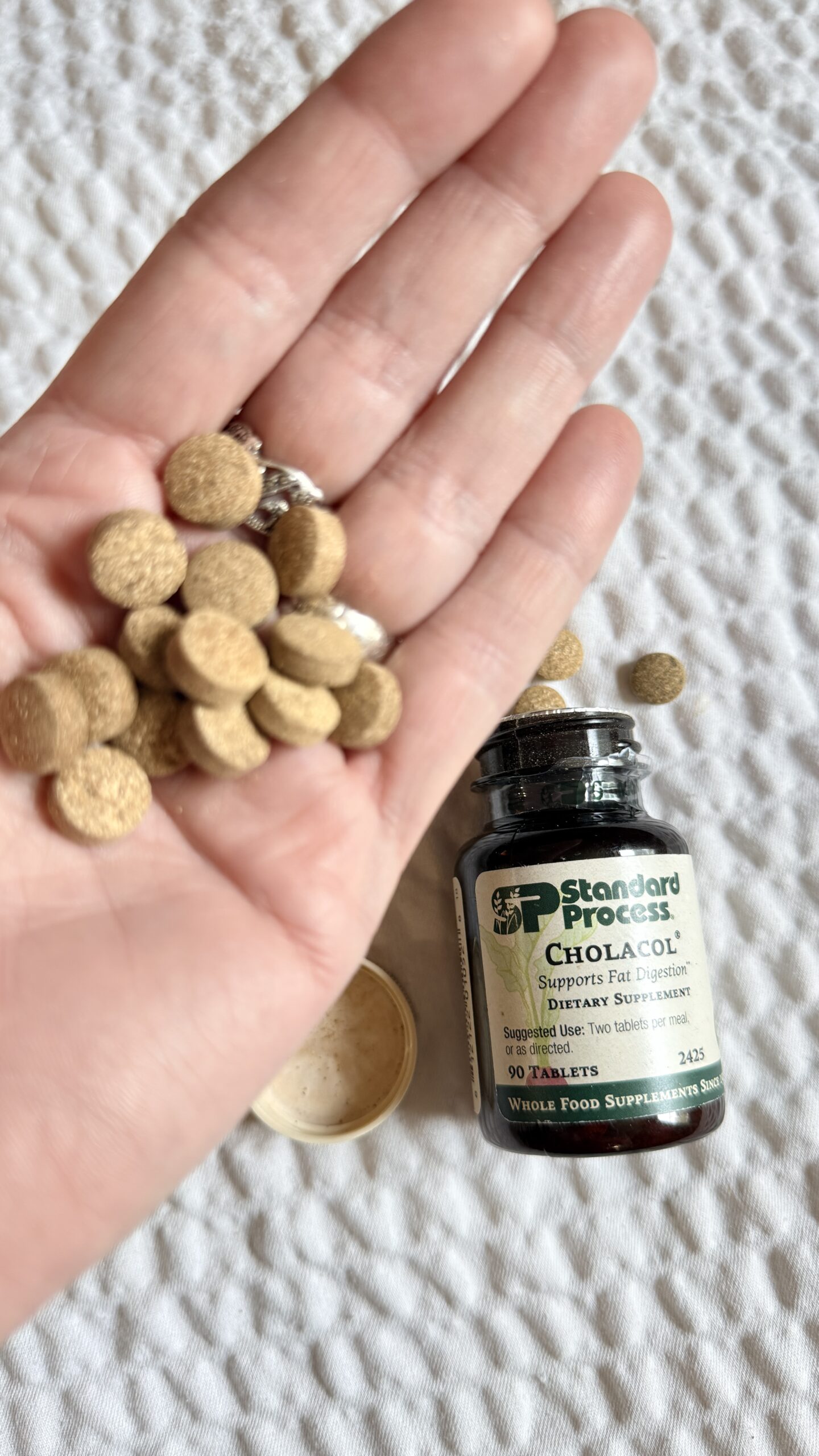
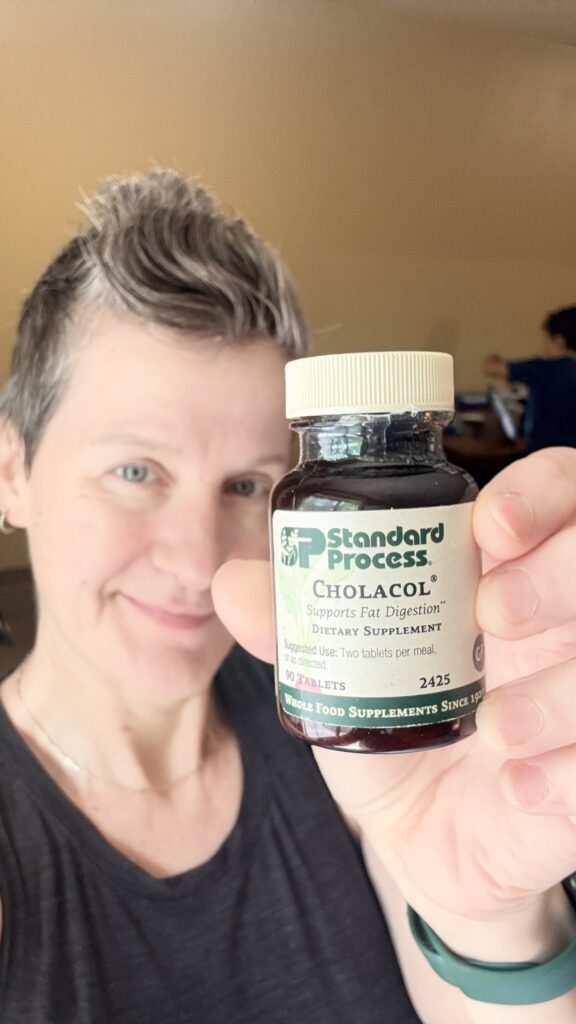
For gallbladder support specifically, I take Standard Process Cholacol. The main ingredients are collinsonia root and desiccated bovine bile. I know how that sounds. It sounded just as bad to me the first time I read the label. But bovine bile is doing the exact job my own bile can’t do well anymore, giving my system a concentrated dose at the moment I need it instead of the slow drip my liver provides on its own. If I want ice cream, I take two beforehand. No cramping, no gas, no spending the next hour regretting it. Just swallow it fast because it tastes horrible.
For general digestion, the kind anyone deals with after a heavy meal or sweet dessert, Shawn and I both use Nutricost Digestive Enzymes. This one isn’t gallbladder-specific. It’s a broader enzyme blend that helps break down fat, protein, and carbs across the board. We reach for it before we eat fast food, fried food, or anything that sits like a brick in our stomachs after a meal that was more grease than substance, so we are feeling bloated and miserable.
Neither of us takes either one daily. The Cholacol comes out when I know I’m eating something with sugar and fat together. The enzyme blend comes out for a few days at a time when something’s already off, not as a daily habit. Neither of us has had a side effect from either one.
What Shawn Takes Differently Than Me
Shawn doesn’t have a gallbladder issue or a bypass to manage. He only takes the Nutricost enzymes, and only when he knows a meal is going to push it, a big greasy plate, fast food, something heavier than what we’d normally cook at home. I know ahead of time when that’s coming, so it’s become a habit between us. I see what’s on the menu and tell him to take it before we eat.
I take the Cholacol for a completely different reason. He’s never needed it and never will, unless his gallbladder gives him trouble down the road. That’s the part people miss when they read one enzyme review and assume it applies to their whole household. What I take and what Shawn takes solve two completely different problems, even though we’re standing in the same kitchen.
The two Things That Make Them Work
Timing matters more than the product. Both of these only work if you take them before you eat, not after the cramping starts. Once the meal is already moving through your system, you’ve missed the window.
The second thing nobody tells you: don’t drink anything while you eat if you’re taking enzymes with the meal. Water dilutes them in your stomach, which means less concentrated support right when you need it most. In fact, you should never drink while eating. We learned this by trial and error, not from a label. Skip the water during the meal, drink it before or after instead.
This aligns with what Harvard Health has reported on digestion slowing down with age. Food stays in your system longer as you age, giving gas more time to build up before it moves through. Taking enzymes before the meal, not during or after, gives them the best shot at actually doing their job before that slowdown works against you.
If you’re dealing with bloating or gas regularly and you’ve never connected it to gallbladder history, fat digestion, or a surgery that changed how fast food moves through your system, it might be worth looking deeper than just cutting out the food itself. I wrote about the broader patterns in signs of poor gut health and the specific foods that were causing my food sensitivities after 50, if you want the fuller picture.
So here’s what I’d actually ask you. When something doesn’t sit right after you eat, do you know why, or do you just blame the food and move on? Have you ever paid attention to whether it’s a specific combination, sugar and fat, dairy and grease, that sets it off every single time? And if you’ve never had a reason to ask your doctor about your own digestive history, what’s stopping you from finding out if something simple like timing an enzyme before a meal could be the fix you’ve been missing?
Digestion changes after 50, and it changes more if you’ve had your gallbladder removed or weight loss surgery. Two different enzyme products solve two different problems for me. Timing before the meal, not after, is what actually makes either of them work.
Do digestive enzymes work for everyone after 50?
No. Most healthy adults with a gallbladder and no digestive surgery history don’t need daily enzyme supplements. They’re most useful for specific situations, like fat malabsorption after gallbladder removal, or digestion that’s been changed by surgery. If you start noticing more discomfort after eating, try them, they won’t harm you and can definitely help
Can you take digestive enzymes if you don’t have a gallbladder?
Yes. Without a gallbladder, bile drips into your system instead of being released in a concentrated burst when you eat fat. Enzyme and bile-support supplements can help fill that gap, especially before higher-fat meals. But, for gallbladder issues specifically, check out cholacol products
Should you take digestive enzymes before or after eating?
Before. Enzymes need to be present when food arrives, not after cramping or bloating has already started. Taking them after a meal is already underway is too late to do much good.
Are digestive enzymes safe to take long term?
For most people, yes, but they’re not meant to be a daily catch-all. I only take mine around specific meals or symptoms, not every day, and I’d talk to your doctor if you’re taking them constantly without knowing why.
Disclosure: GutBeautyBody content is written from personal experience and research. We are not medical professionals. All factual health claims are sourced from peer-reviewed research and reputable health organizations. Read our full Medical Disclosure here.
Disclosure: This post contains affiliate links. If you purchase through our links we may earn a small commission at no extra cost to you. We only recommend products Wendy personally uses and believes in. Read our full Affiliate Disclosure here.