
I took collagen every single day for years.
My nails were still soft and bending. My hair was the same. My skin wasn’t doing anything different. Nothing changed no matter how consistent I was.
I kept buying whatever brand was on sale or had the best reviews but usually just bought the stuff at Costco. I mixed it into my coffee every morning like I was told to do by all the gurus. And I waited for the results that every collagen ad on the internet promised me.
They didn’t come.
So I stopped trusting the marketing and started paying attention to what was actually in the container. That one shift changed everything for me, and it’s why I think most women taking collagen over 50 are wasting their money without realizing it.
Most collagen supplements don’t deliver enough protein per serving to make a difference after 50, when your body needs significantly more protein just to maintain muscle, skin, hair, and nail health, and when absorption issues from aging or surgery can reduce what your body actually uses.
Disclosure: This post contains affiliate links. If you purchase through our links we may earn a small commission at no extra cost to you. We only recommend products Wendy personally uses and believes in. Read our full Affiliate Disclosure here.
What I Was Getting Wrong About Collagen Over 50
Not all collagen powders are created equal, and after 50, the differences matter more than they do at 30.
When you are over 50 your body needs more protein to do the same work it used to do with less. Collagen can be a great source of that protein, but only if the formula actually delivers enough per serving.
I was using brands that had 8 to 10 grams of protein per scoop. Some of them required two to four scoops to get a meaningful amount. I would lose count of scoops and sometimes under- or overuse. The serving sizes were inconsistent, and the containers ran out quickly because most had only 20 servings or fewer.
I also had a factor that most people don’t. I had gastric bypass surgery in 2006, which means my body doesn’t absorb nutrients and supplements the same way. Everything I take needs to be high absorption, or it’s essentially passing through without doing much.
So I started researching differently. Not looking at brands. Looking at labels.
Why Collagen and Protein Both Matter After 50
Your body starts producing less collagen as early as your 30s. By the time you hit 50, that decline is showing up everywhere. Your skin loses elasticity. Your joints get stiffer. Your hair thins. Your nails weaken. According to the Cleveland Clinic, collagen is the most abundant protein in your body and it provides structure to your skin, bones, muscles, and tendons. When production slows down, all of those things feel it.
At the same time, your protein needs are going up, not down. Harvard Health reports that nearly half of adults over 51 are not meeting their daily protein recommendations. After 50, your muscles become less responsive to protein, which means you need more of it just to maintain what you already have. That’s before you even think about building anything new.
Collagen protein is not the same as regular protein. Collagen is missing some essential amino acids that your body needs for muscle building and overall function. It’s great for your skin, hair, nails, joints, and gut. It is not a replacement for the protein you get from food like eggs, meat, fish, or beans. Think of it as one piece of your total daily protein, not the whole thing. You still need to eat well. Collagen fills a specific gap that food alone doesn’t always cover after 50, especially when it comes to your skin, hair, and joints.
So you have two things happening at once. Your body is making less collagen, and it needs more protein. A collagen supplement that actually delivers meaningful protein per serving is addressing both of those problems in one scoop. But most collagen supplements for people over 50 don’t deliver enough protein to make a real difference, and that’s exactly where I was stuck for years.
If you’re wondering why weight gain after 50 feels impossible to fight, protein is part of that equation too. Less protein means less muscle. Less muscle means slower metabolism. It all connects.
Here’s how to figure out how much protein you actually need
Take your weight in pounds and divide it by 2.2. That gives you your weight in kilograms. Then multiply that number by 1.2 if you are mostly sedentary or 1.6 if you are active. The number you get is your daily protein goal in grams. So a 150-pound woman needs somewhere between 82 and 109 grams of protein a day. A 180-pound man needs between 98 and 131 grams. Most people are not getting anywhere close to the amount needed of collagen over 50, and the 18 grams of protein in one scoop of collagen every morning is a solid head start before you even eat breakfast.
What to Actually Look For
I stopped caring about the brand name or even the price and started reading the nutrition panel on the back.
Here is what I look for now in a collagen powder and why each one matters.
Protein per scoop. This is the number that matters most. Some brands give you 8 grams and call it a full serving. I wanted something closer to 18-20 grams per serving.
One scoop only. If the label says two to four scoops per serving, that’s a problem for me. When you’re making coffee at 6 in the morning and have an 8-year-old talking your ear off, asking for breakfast, while you are still opening your eyes, you don’t want to count scoops. One and done.
Servings per container. Some brands give you 20 servings for the same price as one that gives you 31. I won’t spend more than a dollar a day on my collagen. That’s my rule.
Unflavored. I mix mine in coffee with milk, and I don’t want it tasting like vanilla birthday cake. Unflavored also means it blends cleaner and makes the coffee slightly creamier without any weird aftertaste.
Source. I don’t have food allergies, and grass-fed beef collagen agrees with my body. If you have dietary restrictions, marine collagen is a solid alternative. Either way, know what you’re putting in your body and why.
Scent. I can NOT handle when my collagen is stinky. I tried one that had a really pungent scent, and it ruined my coffee for me. I’ve tried over 30 brands. Most have a light scent, but some brands stink.
What Actually Changed
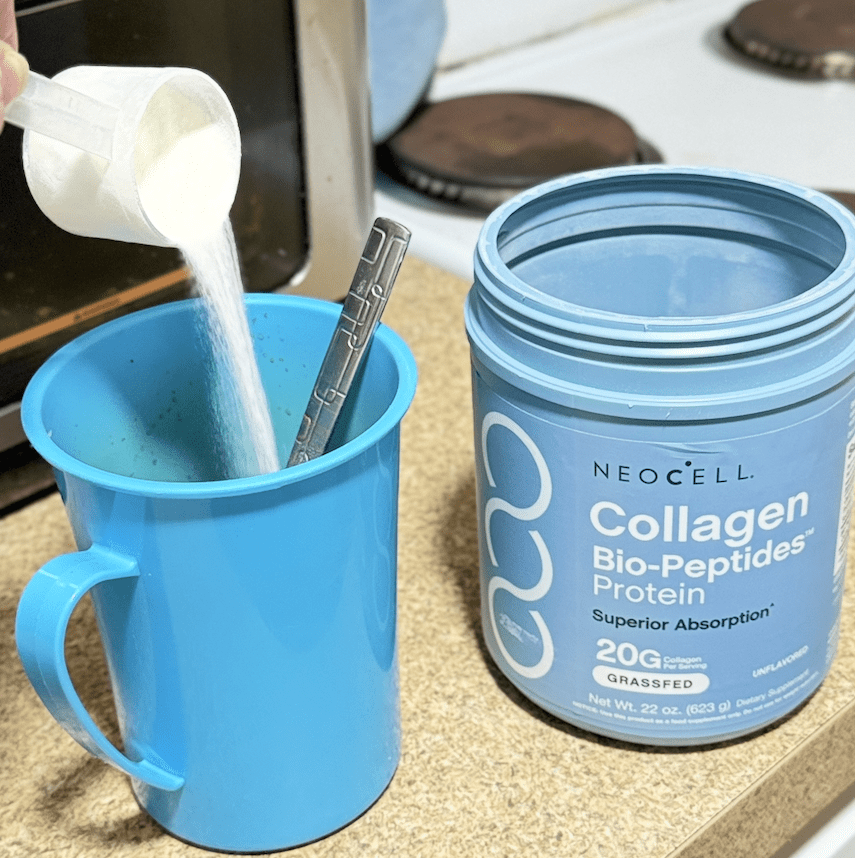
I found a brand that checks every box for me, finally. NeoCell Collagen Peptides. One scoop. 18 grams of protein. 31 servings. Grass-fed. Unflavored. Light scent. Works out to a dollar a day with my monthly Amazon subscription.
I’m not saying this is the only brand that you should try. I’m saying this is the one that works for me after trying a lot that didn’t.
Since I switched last year and started actually paying attention to my protein intake alongside the collagen, here is what I’ve noticed.
My hair is noticeably fuller. Not thicker overnight. Noticeably fuller.
My nails are stronger and don’t bend anymore. They used to peel and fold like paper. Now they actually grow.
My skin overall is healthier. I am not going to claim I look 30. I’m 52. I look like a healthier version of 52, and I’ll take that.
The difference wasn’t the collagen itself. It was the quality, the protein content, and the consistency of actually getting the right amount every day without overthinking it.

What Happened When Shawn Took It
Shawn started taking the same collagen at the same dose.
His nails turned into rocks. His hair started growing faster than he could keep up with. He was shaving twice a day at one point.
So we adjusted.
Now he takes it once, maybe twice a week at most. That’s plenty for him. His body doesn’t need the same amount mine does, and that’s the part most people don’t really think about.
Requirements for protein and collagen over 50 are not a one-size-fits-all situation. What works for me is too much for Shawn. What works for Shawn wouldn’t do anything for me. You have to pay attention to what your body is telling you and adjust.
My Honest Recommendation
Do some trial and error. Don’t marry the first brand you try.
Pay attention to the protein per scoop. Pay attention to how many scoops the label says is one serving. Pay attention to how many servings you get per container.
If you’re dealing with absorption issues or have had any kind of surgery that affects how your body processes supplements, that matters even more. Don’t just grab whatever is cheapest and assume it’s working because you’re taking it daily.
And don’t spend more than a dollar a day. I’ve tried the expensive brands and the cheap ones. Price doesn’t always mean better. The label tells you everything you need to know if you actually read it.
If you have food allergies or sensitivities, look at marine collagen options instead of bovine. Same concept, different source. Still check the protein, the scoop count, and the price per serving.
This is not a miracle supplement. It’s a daily protein source that supports your hair, skin, and nails, but only if you’re getting enough of the right kind. For me, that meant changing brands, paying attention, and being honest about the fact that what I was doing before wasn’t working.
That’s it. No magic. Just better math.

Disclosure: GutBeautyBody content is written from personal experience and research. We are not medical professionals. All factual health claims are sourced from peer-reviewed research and reputable health organizations. Read our full Medical Disclosure here.
Disclosure: This post contains affiliate links. If you purchase through our links we may earn a small commission at no extra cost to you. We only recommend products Wendy personally uses and believes in. Read our full Affiliate Disclosure here.