This isn’t a quiz. There’s no score at the end.
These are questions most people have never stopped to think about. If you can answer most of them, you’re paying more attention than you realize. If you can’t, now you know where to start.
The Simple Six helps you focus on the six things that affect your health and wellness above all others. Ask questions. Advocate for yourself and your family. Track your health journey and become fully aware.
Who we are, and what happened to us
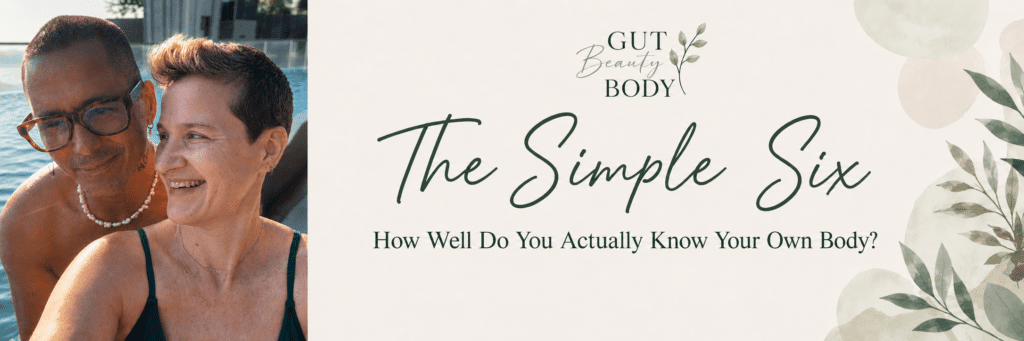
We are Shawn & Wendy Robinson. We’ve been married for 30 years, have 3 kids ages 8-28, have traveled full-time with our family through 39 countries, have raised our kids on the road, and have spent the last 19 years paying closer attention to our health than most people think is reasonable.
We’re not doctors. We’re not wellness influencers pretending we cracked some code.
We’re two people who got tired of not knowing the answers to questions like the ones you just read, and decided to start figuring it out.
Our health and wellness journey began unexpectedly and urgently when our daughter experienced early puberty at only 9 ½ years old. Her longtime pediatrician, whom we had, up until that point, blindly trusted, had no answers to our questions about why or how our daughter got her period so early. We sought a second opinion from another pediatrician. Same response. No real answer was given for her early period, other than “girls are getting it earlier and earlier these days,” which was a truly unacceptable answer for us.
We researched, we dug, we questioned everything. We concluded that her early puberty was most likely due to the food we were feeding her, including meat and dairy with antibiotics, hormones, and GMOs, as well as boxed foods with preservatives, chemicals, and dyes.
We realized that WE did this to her.
So, we tossed all our food out. ALL OF IT. We spent a fortune, which we didn’t have, on healthier food, and I learned to cook and bake in ways we hadn’t paid attention to before. I was reading ingredients and researching them.
Within just 6 months of diet changes, her monthly cycle stopped completely. It didn’t start again until she was 12 ½.
Her doctor never even suggested our diet as the possible culprit. That was our awakening. The single incident that opened our eyes to paying full attention to our bodies, our health, and wellness – asking questions and demanding answers.
And now we hope to help others do the same.
We are constantly researching, reading, testing, questioning, and devouring information that we think others our age would want to know about, even when it doesn’t apply to us directly.
Gut
Your gut isn’t just about digestion. It’s the control center for your immune system, your energy, your skin, your mood, and your ability to absorb everything you put into your body. When it’s compromised, everything else starts falling apart. And most people have no idea it’s the source.
Do you know what your gut is actually doing right now, or do you just assume it’s fine because nothing hurts?
Have you ever connected a skin issue, joint pain, brain fog, or constant fatigue back to your gut, or do you just treat each one like a separate problem and take a supplement or medicine for it?
Do you know the difference between occasional bloating and your body telling you something has been wrong for a while?
Do you track how often you use the toilet, what it looks like, the color, the shape, the smell? Ever?
Do you take vitamins, supplements, or even medications like Prilosec or omeprazole year after year without ever stopping to ask whether you still need them, or whether changing what you eat could resolve the issue entirely?
Nutrition
Every body is different. What works for your partner may not work for you. What your kids thrive on might leave you feeling sluggish. Your genetics, blood type, ancestry, age, and sex all play a role in what your body needs and how it responds to what you give it. Most people never stop to figure out their own patterns. They just eat and deal with whatever happens after.
Do you know roughly how much protein you eat in a day, and how much someone your age and sex actually needs?
Do you know which foods your body responds well to and which it doesn’t, or do you just eat whatever’s in front of you and deal with how you feel afterward?
If you ate too much ice cream tonight, would you already know what’s coming, or would you spend the next three hours wondering if it was dinner, the dessert, or just bad gas?
Have you ever noticed that your body thrives on completely different foods than your partner’s or your kids’, and then asked yourself why that might be?
Do you know whether your genetics, your blood type, your ancestry, or your family’s health patterns play a role in what works for your body versus what works for someone else’s?
Do you know what your body needs right now, or are you following food trends based on an Instagram post you thought was worth a shot?
Beauty
Beauty isn’t just what you put on your skin or how you look in the mirror. What you eat, what you drink, the medicines and supplements you take, and even the perfume or cologne you spray on yourself every morning, all show up on the outside and get absorbed on the inside. Some of it helps you. Some of it is working against you. And most people have no idea which is which.
Do you know whether your skin is dry, oily, combination, or dehydrated?
Have you been using the same soap or cleanser since high school without questioning whether it’s actually good for your skin?
Have you ever looked at the ingredients in your sunscreen, moisturizer, foundation, or perfume?
If so, do you know what each of those ingredients is actually doing to you?
Do you know that what goes on your skin, what you spray on your neck, what you rub into your hands, gets absorbed through your skin into your tissues and your bloodstream?
Are the products you use every day helping your body or working against it?
Have you ever thought about what your breath or your body odor is telling you about what’s happening inside?
Have you noticed your skin or your hair change and just said, “I’m getting older,” without asking a single question about why?
Energy
Low energy isn’t just about sleep, and it’s not just about getting older. It’s a signal. Sometimes it’s what you ate. Sometimes it’s stress you’ve been carrying so long you forgot it was there. Sometimes it’s anxiety or depression showing up in your body instead of your head. Sometimes it’s your environment, your pillow, your room, the screen you were staring at, the box of cookies you ate in bed, or the spouse bouncing around next to you all night. Too many people reach for a pill or a supplement without ever asking what the actual problem is.
Do you wake up tired and just assume that’s what getting older feels like?
Do you know why you didn’t sleep well last night, or do you just know that you didn’t?
Have you considered whether it’s your pillow, your room, the temperature, the light, the screen you were staring at until midnight, or the snack you ate in bed?
Do you know whether your afternoon crash is from what you ate, how you slept, something you’re stressed about, or something deeper you haven’t looked at yet?
Have you ever considered that what feels like low energy might be anxiety, depression, or chronic stress that you haven’t addressed because you don’t even realize that’s what it is?
Do you reach for caffeine or a supplement to push through without ever stopping to ask what the actual problem is?
Weight
Your body after 40 or 50 is not the same as the one you had at 30. Your hormones have changed. Your metabolism has changed. The way your body stores fat, builds muscle, responds to stress, and processes food has all shifted. And most people are still using the same approach that worked twenty years ago, and can’t figure out why nothing is moving.
Are you still doing what worked at 30 and wondering why your body no longer responds?
Do you know whether what you’re dealing with is a food issue, a hormone issue, a sleep issue, a stress issue, or all of them tangled together?
Have you ever lost weight, gained it back, and assumed the problem was discipline rather than the approach you took?
Do you know what your hormones are actually doing right now, or are you just guessing based on how you feel?
Do you know whether you’re eating enough of the right things or just eating less and hoping that works?
Do you know what actually changed in your body after 40, or have you never really looked into it?
Sleep
Sleep affects everything. Your weight, your hormones, your skin, your mood, your ability to think clearly, your immune system. And most people treat it like it’s just the thing that happens between days instead of the thing that determines how every day actually goes.
Do you wake up at 3 am and just accept that as your life now, or pop some melatonin and hope it helps?
Do you know what your sleep actually looks like, or do you just know you’re tired?
Have you changed a single thing about your evening routine in the last year?
Do you know whether your sleep problems are connected to what you ate, what you drank, a medication, your stress, your spouse, your environment, or something your body has been trying to tell you that you keep ignoring?
Have you ever tracked your sleep, your heart rate, or your patterns over time, or do you just know that some nights are bad and some aren’t?
Now What?
If you got through those questions and realized you don’t have answers for most of them, good. That’s just what happens when nobody asks.
Most of us spent our 20s and 30s not thinking about any of this because we didn’t have to. Now our bodies are keeping score, and it’s time for us to take control
Nobody handed us a manual, so we’re writing our own. We share what we find on our blog.
Document your Health & Wellness Journey
If you got through these questions and realized you didn’t research your last blood lab results yourself, you couldn’t list your supplements and doses if someone asked nor understood which ones to, and not to, take together and optimal times of day, and your health history is scattered across three patient portals and a pile of papers in a drawer, and you can’t remember what you ate for breakfast much less all the health issues you’ve ever had much less are dealing with right now, we built something for ourselves that we are now sharing with you.
It’s the same system we use to track our own family’s health. Everything in one place. Labs, meds, supplements, symptoms, family histories, health tracking, and symptom searching based on your entries, and more. So the next time a doctor asks you a question, you can search your phone and, in seconds, have your last lab results, list all your meds, supplements, and dosages, and share when your symptoms started, what you’ve been eating, and anything else you want to keep a record of.
It’s $19 and called the AI Healthcare Assistant. Click the link to learn more.