
Sleep After 50 | The Missing Piece of the Puzzle
You wake up at 3 am. Again. Stare at the ceiling. Your brain starts spinning about all the things on your mind, your to-do list, and even if you locked the doors.
Or maybe you fall asleep fine but wake up feeling like you didn’t sleep at all.
Perhaps your partner says that you’re snoring now. Loud. Every night. And you’re too tired to care.
You sleep hot, your partner sleeps cold. You toss and turn all night. You share a bed or need your own room and space
You pop melatonin. You try sleepy tea. You download sleep apps. Nothing you do seems to make a difference.
Sleep after 50 changes
My husband and I have been together for 30 years. We went from sleeping in the same bed for 20 years to having our own beds while traveling the world with our kids for 10 years – and everything in-between.
We made it all work, but now, in our 50s, it’s harder to just deal with.
Sleep is one of our Simple Six, the six foundational areas we believe determine how you feel after 50.
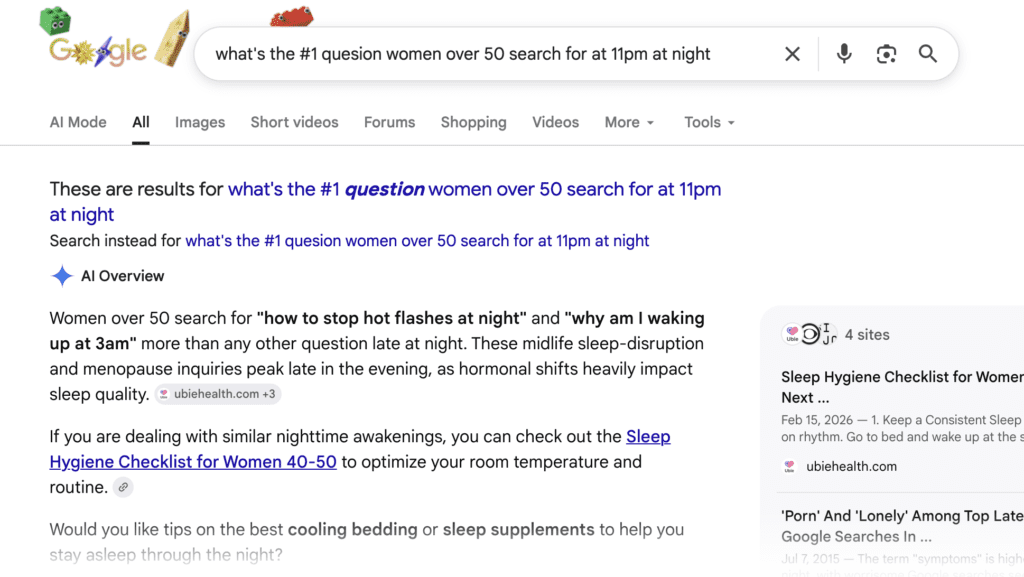
the #1 search on Google at 11pm
I wanted to see what the #1 search question women & men over 50 each look up at 11pm.
Let’s look at what women search for…
To be honest, I was a little anxious when I asked the question from the male angle and figured it would be something sexual.
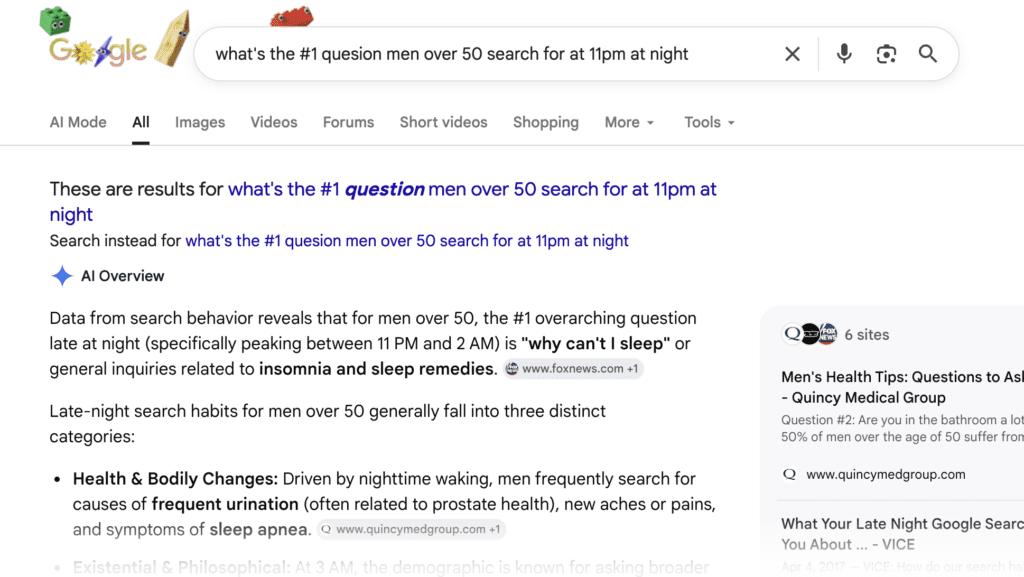
This doesn’t seem acceptable, does it?
Why You Keep Waking Up at 3 AM
Deep slow-wave sleep decreases significantly after 50, while declining melatonin production and shifting hormones like estrogen and testosterone make sleep lighter, more fragmented, and harder to maintain. These biological changes reduce the body’s ability to stay in restorative sleep stages throughout the night for both men & women.
That’s the clinical answer. Here’s the one you’re actually living.
You fall asleep fine. Then, somewhere around 2 or 3 am, your brain switches on like someone flipped a light. Not because of a nightmare. Not because of noise. Your cortisol, the stress hormone that’s supposed to rise gradually toward morning, spikes too early. And once it does, your brain is awake and running whether you want it to or not.
This is the most common sleep complaint we hear from people over 50. Not trouble falling asleep. Trouble staying asleep.
And there’s another piece that doesn’t get enough conversation. Snoring gets worse with age. As you get older, the muscle tone in your throat and airway decreases. The tissues relax more when you sleep. Add weight gain, hormonal changes, or sleeping on your back, and the airway narrows further.
For some people, this is just snoring. For others, it’s sleep apnea, where the airway partially or fully closes during sleep, sometimes dozens of times per hour. You stop breathing, your brain jolts you awake just enough to restart, and you never reach the deep sleep your body needs. You might not even know it’s happening. You just know you’re exhausted no matter how many hours you spend in bed.
Research indicates that sleep apnea rates increase significantly after 50, in both men and women. Menopause raises the risk in women substantially, partly because the hormonal changes that affect everything else also affect airway muscle tone. If you snore heavily, wake up gasping, or feel unrested no matter what you do, a sleep study is worth pursuing. This is one area where getting a real answer changes everything.
The Cost of Ignoring It
You cannot out-supplement bad sleep. You cannot out-exercise it. You cannot caffeinate your way past it forever.
When sleep breaks down, it takes everything else with it.
Your hunger hormones shift. Ghrelin, the one that makes you hungry, goes up. Leptin, the one that tells you you’re full, goes down. You wake up hungrier, less satisfied after eating, and more likely to reach for the fastest, most processed option available. That’s not a willpower failure. It’s a hormonal response to sleep deprivation.
Your energy tanks in ways caffeine can’t fix. Sleep is when your body restores its energy reserves at the cellular level. Shortchange it and you start every day in a deficit. The 2pm crash isn’t just about blood sugar. It’s about the sleep you didn’t get the night before.
Your immune system weakens. Your body does critical repair work during deep sleep. Chronic poor sleep leaves you more vulnerable to illness and slower to recover.
Your skin accelerates aging. The repair processes that maintain collagen, hydration, and cellular turnover happen during quality sleep. Cut those short and it shows on your face before almost anywhere else.
Your cortisol stays elevated, which drives belly fat storage, increases inflammation, and makes recovery from exercise harder.
Everything you’re working on during the day, the nutrition, the movement, the stress management, gets undermined by what’s not happening at night.
Fixing the Environment (And the Habits)
Start with the room. Not the supplements, not the routines. The room.
Temperature matters more than most people realize. Your core body temperature needs to drop to initiate and maintain deep sleep. A cooler room, somewhere around 65 to 68 degrees, supports this. A warm room fights it. If you and your partner disagree on the temperature, separate blankets can solve a lot of arguments and sleep problems.
And…maybe this stage of life also requires a massive sleep overhaul. We have our own beds now. We sleep in the same room, but if my husband snored louder and more consistently, then maybe we’d need a bigger house with more rooms.
Darkness is not optional. Even small amounts of light suppress melatonin production and disrupt sleep architecture. Blackout curtains or a sleep mask. Simple, cheap, effective.
And the partner factor. This one doesn’t get enough honest conversation. If your spouse snores, tosses, runs hot, keeps a different schedule, or has undiagnosed sleep apnea, their sleep problems become your sleep problems. Separate blankets help. A fan for white noise helps. Sometimes separate sleep schedules or even separate rooms help. There’s no shame in it. Sleeping well matters more than sleeping in the same bed every single night.
We’ve decided, now that we’re back in the states, to have our own separate beds. We sleep in the same room, but if my husband snored louder and more consistently, then maybe we’d need a bigger house with more rooms.
During the day, get natural light in the morning. Exposure to sunlight within the first hour of waking anchors your circadian rhythm and directly improves sleep quality that night. This is one of the most consistently supported findings in sleep research, and it costs nothing.
At night, cut the screens. Blue light from phones, tablets, and TVs signals your brain that it’s still daytime and delays melatonin production. Dimming lights and putting screens away in the hour or two before bed makes a measurable difference. Most people know this, but don’t do it.
The Food and Movement Connection
What you do during the day dictates the night.
Eating a huge meal late keeps your digestive system active when your body wants to shift into repair mode. It spikes insulin at the wrong time and disrupts the hormonal cascade that initiates deep sleep. We stopped eating heavy meals after 7 pm, and the difference is noticeable. We also have fewer heartburn side effects.
Alcohol is the most common sleep saboteur that people don’t want to hear about. It might help you fall asleep. It consistently fragments sleep architecture, reduces REM sleep, and leaves you less restored than you would have been without it. This effect gets more pronounced after 50. A glass of wine at dinner and a glass of wine at 9pm produce very different results.
Caffeine has a longer half-life than most people realize. Research indicates it takes five to six hours to clear half of it from your system, and longer for some people. Caffeine consumed after early afternoon remains active at bedtime, even if you don’t feel wired. After 50, this sensitivity tends to increase. So even having a soda at dinner can make a difference.
On the movement side, walking outside daily does more for sleep than most supplements. Natural light plus moderate activity plus fresh air supports circadian rhythm, reduces cortisol, and creates the kind of gentle physical demand that promotes deep sleep.
Resistance training drives deeper, more restorative sleep because the body needs recovery time to repair muscle tissue. That recovery demand is what pulls you into slow-wave sleep. This is one of many reasons we prioritize lifting over cardio.
The worst thing for sleep is being sedentary all day and then trying to fix it with melatonin at night. Your body needs physical demand during the day to sleep deeply at night. No supplement replaces that.
The Simple Six focus points
Everything related to your health and wellness comes down to these. Make them a priority, and you will see the difference.
If Your Digestion and Immunity Are Off
Your gut runs more than you think. Digestion, energy, mood, immunity, and even skin. When it’s off, everything is off. This is the foundation for your entire body.
If You Don’t Know What to Eat Anymore
Protein matters more now than ever before. Processed food hits harder. And most nutrition advice out there isn’t written for someone managing a full life after 50.
If Your Skin Is Changing
Skincare products alone can’t resolve internal issues and might even make them worse. Factors like gut health, nutrition, sleep, and stress all impact your face before any cream has a chance to work.
If You are constantly low energy
When the clock strikes 7, and you’re ready to cancel dinner plans because you’re too tired to go out. It usually traces back to a few fixable things, and fixing them changes everything else, too.
If the Scale Won’t Budge
Midlife weight gain isn’t just about calories. Hormones, sleep, gut health, and stress all play a role. We break down what’s actually happening and what shifts make the biggest difference so you can feel and look your best.
If You’re Waking Up Exhausted
You can’t out-supplement bad sleep. You can’t out-exercise it either. And you certainly can’t keep accepting it. Poor sleep affects weight, mood, metabolism, recovery, and almost every health marker that matters.
Check Your Own Baseline
If you’re not sure what’s actually waking you up, the Simple Six Self-Check is the fastest way to start. It takes five minutes, covers all six pillars, and gives you a starting point.
If you suspect sleep apnea, don’t guess. Get a sleep study. I’ve done a sleep study. It’s weird, but it really can tell you what’s going on. That’s one piece of the puzzle that needs a real answer, not a workaround.

About Shawn and Wendy Robinson
Shawn & I met in 1996, started a family, and have built a beautiful life. We’ve also built multiple startups and a Direct Sales business, and have supported ourselves with multiple streams of location-independent income, training thousands of people globally along the way.
Over the past 20 years, we’ve explored health and wellness through personal experience, experimenting with various diets, raising kids, managing health scares, food sensitivities, and weight changes, as well as traveling to 39 countries. These journeys showed us how food quality, lifestyle, and culture influence physical and mental aging. We’re practitioners, not gurus. Everything here stems from real-life experiences, personal advocacy, and taking control.
Disclosure: GutBeautyBody content is written from personal experience and research. We are not medical professionals. All factual health claims are sourced from peer-reviewed research and reputable health organizations. Read our full Medical Disclosure here.